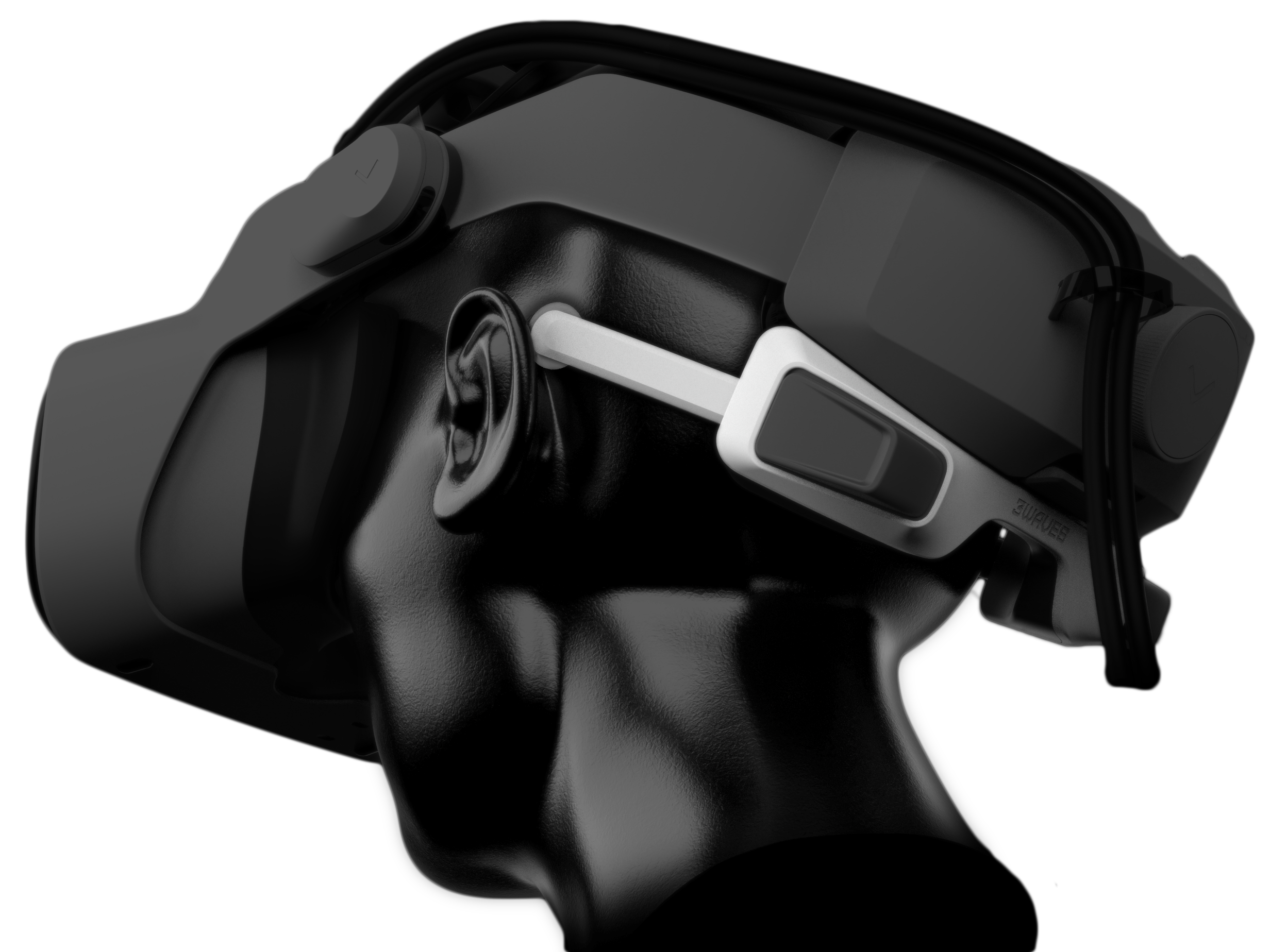
The Science Behind 3WAVES
How vestibular stimulation makes simulated motion feel real.
How vestibular stimulation makes simulated motion feel real.
The vestibular system is the body's balance control center, managing coordination and spatial awareness through three critical inputs:
What the eyes see
Vestibular signals
Physical sensation
This system works flawlessly in normal conditions, but becomes unreliable when there's a mismatch, such as seeing motion in a simulator without feeling it. That's when sim sickness strikes.
Simulators opened incredible training possibilities at accessible costs, but with one major limitation: they engage only the visual system.
This creates oculo-vestibular decoupling -- the eyes see movement the body doesn't feel, triggering nausea, fatigue, and shortened training sessions.
For defense and aviation training, where session duration and trainee comfort directly impact readiness, this limitation has been a significant barrier to adoption.
Our technology solves this fundamental mismatch by providing the missing vestibular input, creating harmony between what trainees see and feel.
The result is extended, comfortable, and realistic training that improves performance across flight, maritime, and crew simulation scenarios.
Reduced sim sickness means longer, more productive training time.
Skills developed with vestibular feedback transfer more effectively to real-world operations.
Works with any headset, dome, or simulation platform. No infrastructure changes needed.
Single-use electrodes provide safe, comfortable vestibular stimulation with no side effects.
The science behind 3WAVES comes from more than fifteen years of vestibular research, studied and validated in clinical settings.
3WAVES licenses that work and has built it into a system made for defense simulation and training.
3WAVES is non-invasive by design. The cue is a small, current-controlled signal applied at the skin, well below any level associated with tissue or electrical injury, and its effects are transient and reverse the moment stimulation stops.
Nothing is implanted and no force is applied to the body. The signal shapes perception, not motion, and any sensation ends with the cue.
Current-limited hardware, default-safe disconnection, bounded software limits, and explicit stop controls, engineered with IEC 60601 and 60479 as guidance.
Reviewed and approved through Institutional Review Boards across research and training use.
More than 100 service members have trained on the system across multiple defense sites, in engineering testing, human-subject research, and live training.